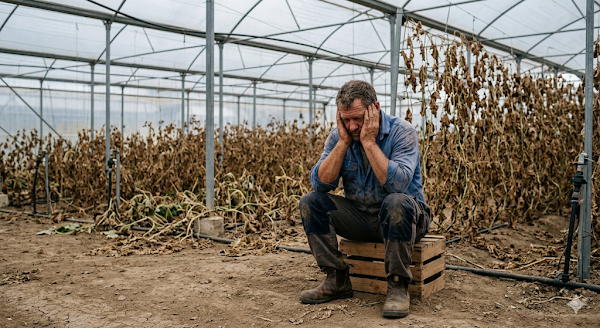
India’s agricultural landscape is rapidly changing. Desertification, declining groundwater levels, rising temperatures, and unpredictable weather are making traditional open-field farming increasingly difficult in many regions. Because of this, protected agriculture — including polyhouses, greenhouses, shade nets, and hydroponic systems — is being promoted as the future of farming due to its better water efficiency, crop protection, and yield consistency.
At the same time, rising unemployment, shrinking business margins, and social media success stories have encouraged many urban professionals, NRIs, retired individuals, and business families to explore polyhouse farming as an investment opportunity. However, most people living in metropolitan cities have little practical exposure to farming, making them heavily dependent on agro-consultancy companies that offer complete end-to-end solutions ranging from polyhouse construction and hydroponic setup to crop planning and operational consultancy.
But protected farming is not simply about building a structure and planting an exotic crop. It is a technical and management-intensive business that requires practical knowledge, proper planning, market understanding, and continuous involvement. Urban investors should carefully understand the realities of this sector before investing large amounts of capital.
1. Projected profits are often exaggerated by consultants
One of the biggest mistakes urban investors make is trusting profit projections shared by agro-consultants at face value. Many consultants present crop prices in a way that sounds highly attractive, but these numbers are often based on retail prices rather than actual wholesale market rates. This creates a misleading picture of profitability and encourages investors to expect returns that are far higher than what is realistically possible.
For example, in the case of lettuce, a consultant may tell you that the crop can sell for around ₹200 per kg. Many new investors believe this figure because it is close to the retail price they see in supermarkets or premium stores. However, in the actual wholesale market, lettuce prices fluctuate heavily. For much of the year, the average price may be around ₹70 per kg, and ₹200 per kg may be seen only for a small number of days when demand spikes. In reality, such high prices are not the norm.
The same issue is seen with exotic vegetables. Investors are often shown attractive pricing assumptions such as ₹300 per kg, but the actual wholesale realization may be closer to ₹70 per kg in many cases. Without understanding the difference between retail pricing, wholesale pricing, and seasonal price fluctuations, an investor can easily overestimate revenue and underestimate risk.
This is why urban investors should never rely only on promised figures. They must verify market prices independently, study local mandi trends, understand seasonality, and ask for conservative rather than optimistic projections.
2. Project costs are often unnecessarily inflated
Another common problem in protected farming is the inflation of project costs. Many urban investors believe that spending more money automatically leads to higher profits, and this is often encouraged by consultants and suppliers promoting expensive infrastructure and imported technologies.
In many cases, consultants recommend systems that significantly increase the project cost because they also earn commissions or margins from suppliers. As a result, investors may end up paying for infrastructure that looks advanced but does not generate proportional returns.
For example, a consultant may insist on expensive hydroponic systems like Dutch buckets or fully climate-controlled polyhouses by claiming they produce superior yield and quality. While these systems do have advantages, the additional investment often does not justify the actual returns, especially when market prices remain volatile.
Urban investors should remember that agriculture is a margin-based business. The focus should be on building a financially sustainable operation, not simply the most expensive setup.
3. Starting farming without understanding the basics can become financially dangerous
Entering any business without understanding its fundamentals is risky, and agriculture is no exception. Many urban investors enter polyhouse farming with little or no practical knowledge, assuming that consultants will manage everything for them. This creates complete dependency on external guidance, which can become dangerous during operational or financial crises.
An investor should first spend time learning the basics of farming through internships, farm visits, or hands-on experience. Understanding soil quality, irrigation, crop seasonality, pest attacks, labor management, and actual market pricing is extremely important before investing large amounts of money.
In many cases, the business model of agro-consultancy firms is not always fully aligned with the investor’s long-term success. Some firms earn more from selling infrastructure, fertilizers, pesticides, or recurring consultancy services than from the actual profitability of the farm. As a result, investors who lack technical knowledge may end up overspending on unnecessary inputs or become helpless during emergencies when timely decisions are required.
Consultants can guide a project, but the investor must still understand the core fundamentals of the business they are entering.
4. Understand the seasonality of your crop and the reason behind it
One of the most important aspects of profitable farming is understanding why a crop becomes expensive during a particular season. Many beginners only look at current market prices without understanding the supply cycle behind them.
For example, exotic bell peppers usually sell at higher prices during summers in North India because the crop naturally performs better in cooler conditions and becomes difficult to grow in open fields during extreme heat. During winter, when supply increases, prices often fall sharply.
This is where polyhouse farming can create a real advantage if managed intelligently. A farmer who plants slightly earlier than others can protect seedlings from rain and adverse weather conditions, allowing the crop to enter the market earlier. Even a timing advantage of 10–15 days can help growers capture premium prices before market supply increases.
Successful protected farming is not only about growing exotic crops — it is about understanding market timing, supply gaps, and seasonality better than others.
5. If you are growing in soil, maintaining soil health is extremely important
Many beginners assume that once a polyhouse is built, the soil inside will automatically remain productive for years. In reality, soil health management is one of the most critical parts of successful protected farming.
Continuous cultivation inside a polyhouse can gradually lead to soil fatigue, salt buildup, fungal diseases, nematode problems, and declining productivity if the soil is not properly maintained. This is why practices such as soil solarization, proper drainage, and periodic soil treatment become very important.
Investors should also focus on improving soil quality through regular addition of organic matter such as compost, vermicompost, cocopeat, and other natural amendments. Healthy soil improves root development, water retention, microbial activity, and overall crop performance.
A polyhouse can protect crops from external weather, but poor soil management can still destroy productivity from within.