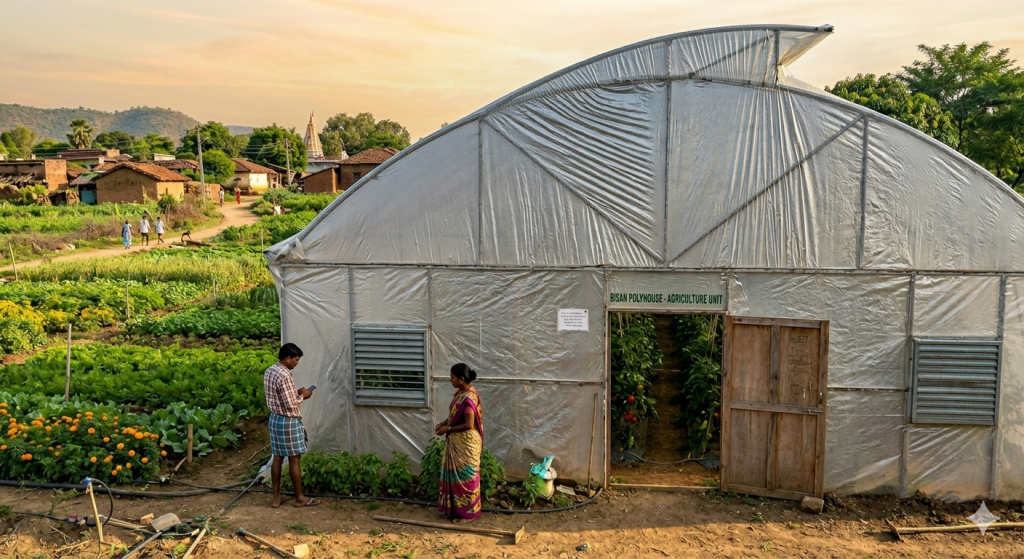
As global warming accelerates, weather patterns are becoming increasingly erratic — unpredictable monsoons, unseasonal frost, and prolonged droughts are threatening traditional open-field agriculture. Greenhouse farming offers a practical solution by creating a climate-controlled environment that protects crops from weather extremes and enables year-round cultivation.
States like Punjab, once considered India’s agricultural backbone, are now facing serious challenges such as falling water tables, degraded soil, and shrinking green cover. Polyhouse farming helps tackle these issues by maximising yield per square foot while using resources more efficiently. With systems like drip irrigation, water usage can be reduced by up to 70% compared to conventional farming — a major advantage for the future of Indian agriculture.
At Agro Dharti, we help farmers not only set up polyhouse projects but also choose the right high-profit crops based on market accessibility, demand in Tier 1 and Tier 2 cities, climate suitability, transportation feasibility, and long-term profitability. We guide growers in crop planning, market linkage opportunities, and modern cultivation techniques to improve returns while reducing risk. Most importantly, we believe in practical and transparent guidance — we do not create unrealistic income expectations or attract farmers with exaggerated vegetable price charts and misleading profit claims. Our focus is on building sustainable, long-term success for growers.
In an era of climate uncertainty, greenhouse farming is not just an alternative — it is the future of sustainable agriculture. Today, we will discuss 5 profitable crops for polyhouse farming that every modern farmer should know about.
Crop 1: English Cucumber (Seedless Variety)
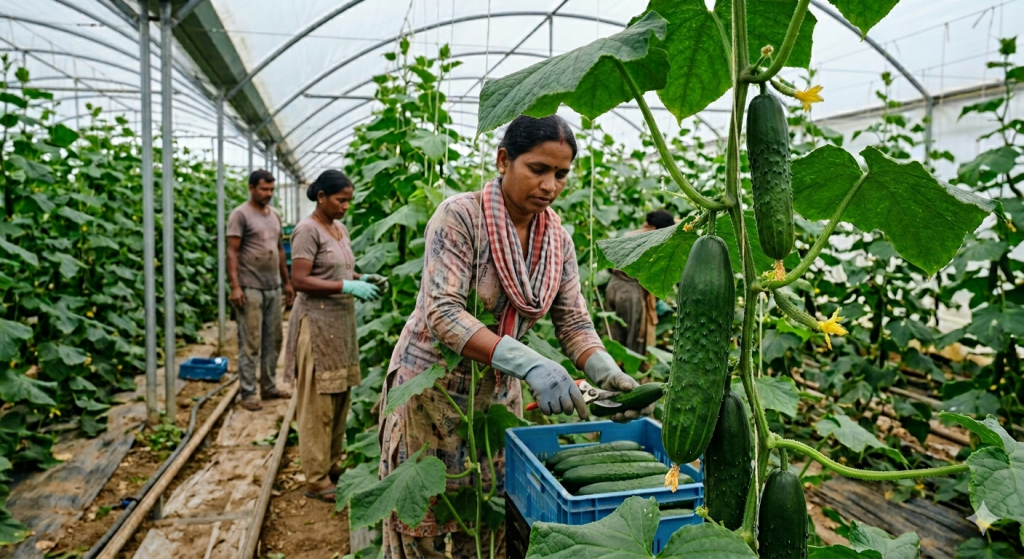
English cucumber is one of the most lucrative cash crops for greenhouse farming in North India. With the first yield arriving in just 45 days, it offers one of the fastest returns on investment among greenhouse vegetables, making it ideal for farmers seeking quick cash flow.
Per acre, a farmer can plant 8,500 plants, with each plant yielding approximately 4 kg of produce. This gives a gross yield of 34,000 kg per acre. Accounting for a standard 10% spoilage, the marketable yield comes down to 30,600 kg. At an average selling price of ₹17 per kg, the total revenue per acre stands at a healthy ₹5,20,200.
The seedless variety commands consistent demand from urban markets, supermarkets, and hotels, ensuring stable pricing throughout the year. Since it can be grown round the year in North India within a controlled greenhouse environment, farmers can harvest multiple cycles annually, multiplying this revenue several times over — making English cucumber a truly profitable greenhouse crop.
Crop 2: Desi Tomato (Greenhouse Variety)
Tomato is a staple cash crop and one of the most reliable income generators for greenhouse farmers in North India. High-yielding varieties like Arka Rakshak are particularly well-suited for greenhouse cultivation, offering strong disease resistance and consistent produce quality throughout the season.
Sown in August, the crop runs through a productive 8-month cycle, spanning from August/September all the way to April/May — covering the high-demand winter and spring markets when tomato prices tend to remain stable and favourable.
Per acre, a farmer plants 8,500 plants, with each plant delivering an average yield of 10 kg, resulting in a gross yield of 85,000 kg. After accounting for the standard 10% spoilage, the marketable yield is 76,500 kg. At a wholesale price of ₹10 per kg, the total revenue per acre works out to ₹7,65,000 for the season.
Compared to open-field tomato cultivation — which is highly vulnerable to blight, frost, and erratic rainfall — greenhouse-grown tomatoes offer superior quality, fewer crop losses, and better shelf life, making them more attractive to wholesale buyers and retail chains alike. For North Indian farmers, this 8-month crop represents one of the most dependable and high-value greenhouse investments available.
Crop 3: Cherry Tomato (Greenhouse Variety)
Cherry tomato is a premium cash crop that is rapidly gaining popularity among greenhouse farmers in North India, driven by surging demand from urban consumers, salad bars, five-star hotels, and modern retail chains. Like its regular counterpart, high-yielding varieties thrive beautifully in a controlled greenhouse environment.
Sown in August, the crop follows the same 8-month cycle from August/September through to April/May, covering the peak winter and spring demand period. Per acre, a farmer plants 8,500 plants, however, cherry tomato yields a comparatively lower 4 kg per plant, giving a gross yield of 34,000 kg. After the standard 10% spoilage deduction, the marketable yield stands at 30,600 kg.
Here is where cherry tomato truly sets itself apart — at a wholesale price of ₹50 per kg, the total revenue per acre comes to an impressive ₹15,30,000 for the season, nearly double that of regular greenhouse tomatoes.
The smaller fruit size, vibrant appearance, and sweeter flavour profile command a significant price premium in the market. For farmers already running greenhouse infrastructure, switching to or incorporating cherry tomatoes alongside regular crops can dramatically improve per-acre profitability, making it one of the highest-value crops in the greenhouse farming portfolio.
Crop 4: Lettuce (Grow Bag Cultivation)
Lettuce is one of the fastest-growing crops in the greenhouse farming space — and unfortunately, also one of the most aggressively over-marketed by greenhouse consultancy companies across India. Let us look at the real numbers first.
Lettuce is grown in grow bags, allowing a significantly higher plant density of 24,000 plants per acre. Each 45-day cycle yields approximately 4,000 kg (4 tons). With 8 cycles possible in a year, the annual yield stands at 32,000 kg. At an average wholesale Mandi price of ₹60 per kg, the total annual revenue per acre comes to ₹19,20,000 — an impressive figure on paper.
However, here is the ground reality that many farmers are not told upfront. Lettuce demands a high-tech, climate-controlled setup, particularly to manage the intense North Indian summers, requiring heavy investment in cooling systems, shade nets, and precise humidity controls. This significantly drives up the capital cost of the polyhouse.
More critically, many greenhouse consultancy companies routinely quote inflated average prices of ₹80–₹120 per kg to prospective buyers, painting an unrealistically rosy picture of returns. When farmers eventually sell at actual Mandi rates, the numbers fall well short of projections. The result — a high-cost infrastructure with an ROI that can stretch into several years, leaving many small and mid-scale farmers in financial stress.
Lettuce can be profitable, but only for farmers with direct access to premium buyers such as hotels, restaurants, and modern retail chains who can bypass the Mandi altogether. Entering lettuce cultivation purely on the basis of a consultancy company’s pitch, without securing buyers in advance, is a risk that must be carefully evaluated.
Crop 5: Exotic Bell Pepper — Red & Yellow (Greenhouse Variety)
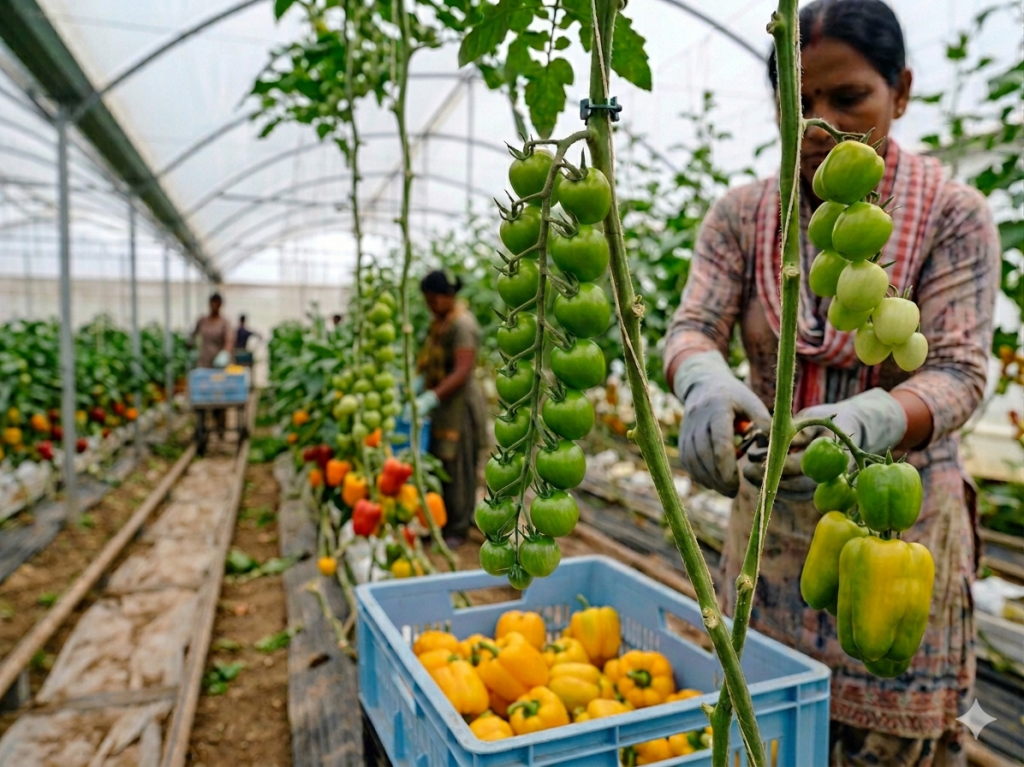
Exotic bell pepper, particularly the red and yellow varieties, is among the most visually striking and premium-priced crops in the greenhouse farming portfolio. With consistent demand from hotels, restaurants, modern retail, and export markets, it holds genuine commercial potential — but like lettuce, it comes with important caveats that every farmer must understand before investing.
Following the same season as tomatoes, the crop is sown in August/September and runs through to April/May, covering 8 productive months. Per acre, a farmer can plant 12,000 plants, with each plant yielding an average of 2.5 kg, giving a gross yield of 30,000 kg. After the standard 10% spoilage deduction, the marketable yield stands at 27,000 kg. At a wholesale average price of ₹60 per kg, the total seasonal revenue per acre comes to ₹16,20,000 — a strong return on paper.
However, the reality in the field tells a more cautious story. Exotic bell peppers are another crop routinely used by other greenhouse consultancy companies to lure farmers with inflated price projections of ₹80–₹150 per kg, far removed from what most farmers actually realise at the Mandi. Red and yellow bell peppers do command a premium over the common green variety, but that premium is heavily dependent on buyer access, produce quality, and market timing.
Add to this the fact that bell pepper requires a high-quality polyhouse structure, proper trellising, precise nutrient management, and climate control — all of which push the capital investment significantly higher. For farmers without direct institutional buyers lined up, the gap between projected and actual revenue can make ROI stretch uncomfortably over multiple years.
Exotic bell pepper is genuinely profitable — but only when sold through the right channels. Securing contracts with hotels, supermarkets, or exporters before setting up infrastructure is not optional advice — it is essential.