Many people believe that once a polyhouse is built, farming automatically becomes profitable. But in reality, the growing system you choose inside the polyhouse is equally important. Two farmers can grow the same crop in similar structures and still get very different results because of differences in irrigation, root-zone management, nutrition control, and cultivation methods.
In modern polyhouse farming, success is not just about growing crops — it is about growing them efficiently and consistently. Your growing system affects yield, crop quality, disease management, water usage, labor requirements, and overall profitability. Choosing the wrong system without proper understanding can lead to unnecessary expenses and poor returns.
Before reading this blog, we highly recommend going through our previous blogs where we discussed the real economics, opportunities, and practical side of protected cultivation in India:
- “5 Ground Realities of Polyhouse Farming Most Urban Investors Ignore in India”
- “5 Profitable Polyhouse Crops in India”
- “Types of Polyhouses in India: Complete Guide & Cost Saving Tips”
Now in this blog, we will understand the 3 major growing systems used in polyhouse farming and which type of farmer each system is actually suitable for.
1) Growing in NFT Hydroponic System
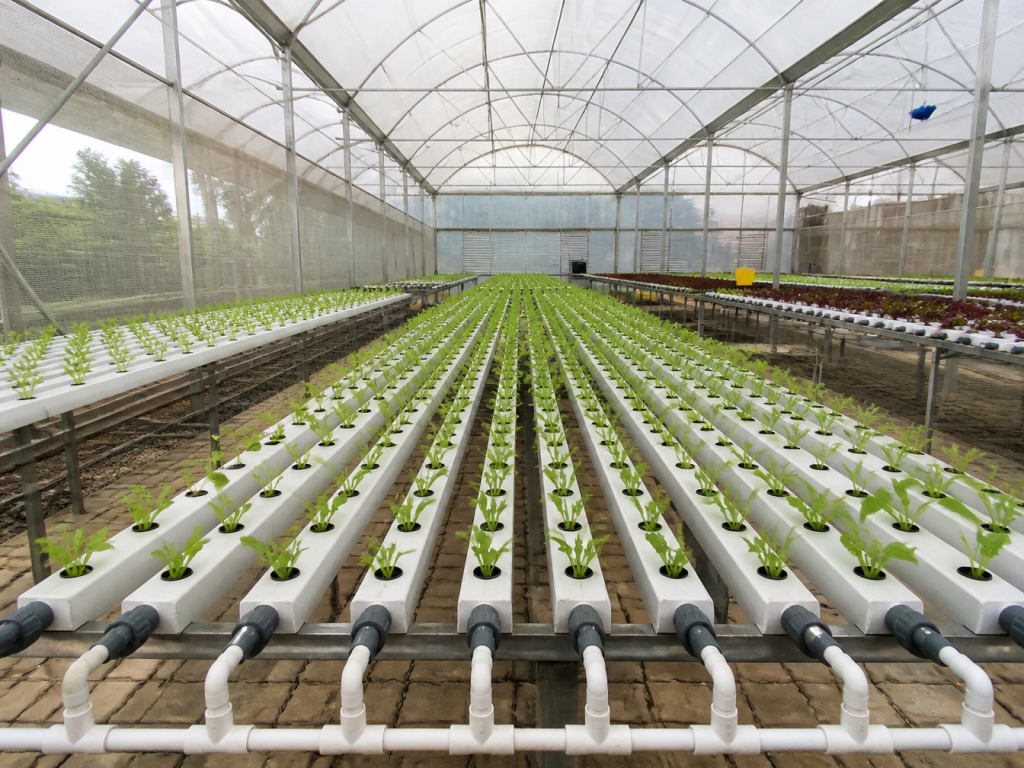
NFT (Nutrient Film Technique) hydroponic growing system and one of the most advanced polyhouse growing systems . In this plant roots are placed inside long channels or pipes, and a thin continuous flow of nutrient-rich water passes directly over the roots. Since plants do not grow in soil, all nutrients are supplied through water in a controlled manner. This system is commonly used for leafy vegetables like lettuce, arugula, basil, and other exotic greens.
Setting up an NFT hydroponic system can cost around ₹25–40 lakhs per acre, apart from the polyhouse construction cost itself. While this system can deliver extremely high productivity, it is not recommended for beginners or even average growers who do not have strong market access for premium produce.
NFT requires precise nutrient management, constant monitoring of pH and EC levels, and strong disease-control knowledge. Since roots remain directly exposed to water, problems like root rot can spread very quickly and destroy the entire crop within days.
This system is like riding a high-speed sports bike in heavy traffic — an expert rider can move much faster and reach profits earlier, but one mistake can also lead to major losses. Skilled growers can achieve multiple crop cycles per year and sometimes produce many times higher yield from the same piece of land.
2) Growing in Cocopeat in Grow Bags

Cocopeat-based growing is a middle path between NFT hydroponics and soil farming. This polyhouse growing system offers a natural buffer to the plant because the root zone can hold some moisture and nutrients, unlike NFT where roots depend entirely on flowing solution. In soil, the soil solution and soil particles help buffer nutrient availability, so the plant does not react immediately to every small change in fertilizer strength, pH, or moisture. Cocopeat also gives this benefit, but not as strongly as soil, so it provides some margin for error while still requiring careful management.
In this system, you still need proper nutrient recipes and regular EC and pH monitoring, but you get a little more room for mistake compared to NFT. That is why cocopeat in grow bags is a more practical option for crops like tomato, cucumber, exotic bell pepper, and cherry tomato, because it provides better root support than NFT and is easier to manage.
This system is also much cheaper than NFT. A simple LDPE grow bag may cost only around ₹10–20 per bag. Still, many consultants try to upsell expensive grow buckets, Dutch bucket systems, or HDPE-based setups. While these systems may have some advantages, they are often not justified in India when ROI is considered. Overall, yields are much higher than soil farming, though still lower than NFT. The total setup cost is usually around ₹3–4 lakhs on top of the polyhouse cost.
3) Growing in Soil
Yes, you heard it right — even modern polyhouse farming can be successfully done in soil. In fact, many experienced growers still prefer soil cultivation because of its lower risk, lower setup cost, and more natural growing environment.
3.A) Directly Growing in Soil
In this method, crops are planted directly into prepared beds inside the polyhouse. A drip irrigation system is generally recommended instead of traditional channel irrigation because it provides better water efficiency and fertigation control. A basic drip setup usually costs only around ₹50,000–₹1 lakh.
Before planting, the soil is properly prepared through solarization to reduce pests and diseases. Basal doses such as neem cake, vermicompost, FYM, and bone meal are added to improve soil health and microbial activity. Beds are prepared and covered with mulch sheets to reduce weeds and maintain moisture.
This is the cheapest and safest growing system because soil has excellent buffering capacity for nutrients, moisture, and temperature fluctuations. Plants also tend to grow more naturally with stronger biological activity around the roots. Although yields are generally lower than NFT and cocopeat grow bags, growers can still achieve very good production with proper management and crop planning.
3.B) Soil in Grow Bags
In this method, treated soil is filled inside grow bags instead of planting directly into the ground. This helps reduce soil-borne diseases, provides better control over soil quality and soil mix, and improves excess water drainage. Another advantage is that growers do not need to prepare permanent soil beds inside the polyhouse, which compensates for some of the additional cost of purchasing the grow bags.
Yields are usually slightly better than, or sometimes almost similar to, direct soil cultivation depending on management practices. The rest of the farming methods — including drip irrigation, fertigation, mulching, and crop management — remain largely the same.
Conclusion
Choosing the right growing system is one of the most important decisions in polyhouse farming. A highly advanced setup may look attractive, but the real goal should always be sustainable profitability and good return on investment. In many cases, a simpler and well-managed system can generate better long-term returns than an expensive “hi-tech” setup that is difficult to operate or maintain.
At DhartiAgro, we focus on practical and commercially viable solutions. We understand your location, climate conditions, water quality, target crops, and budget before recommending any growing system. Our aim is not to push fancy technologies just to increase project cost, but to suggest systems that offer the best balance between investment, risk, yield, and ROI. Because at the end of the day, farming is not just agriculture — it is also a business.