India’s agriculture is at a crucial stage. With a growing population, shrinking farmland, unpredictable weather, and rising food demand, open-field farming alone may not be enough in the coming years. This is why polyhouse farming is becoming increasingly important in India. It helps farmers grow crops in a controlled environment, improve yield and quality, and produce throughout the year. Today we will discuss – types of polyhouses in India: Complete Guide & Cost Saving Tips
Another major advantage is water efficiency. Systems like drip irrigation and fertigation reduce water wastage, which is especially important in states like Punjab, where falling groundwater levels are a serious concern. Polyhouses also support the growing demand for exotic and high-value crops such as colored capsicum, cherry tomatoes, lettuce, cucumbers, strawberries, and flowers in urban markets.
At the same time, many new investors enter this field with unrealistic expectations due to aggressive marketing by consultants and companies. That is why it is important to understand the real commercial side of polyhouse farming before investing.
I have already written 3 previous blogs covering:
- 5 Ground Realities of Polyhouse Farming Most Urban Investors Ignore in India
- 5 Profitable Polyhouse Crops in India
Today, we will discuss the different types of commercial polyhouses used in India, their practical uses, actual costs, and how these costs often differ from what consultants may claim.
1) Insect Net & Shade Net Polyhouse – The Complete Guide
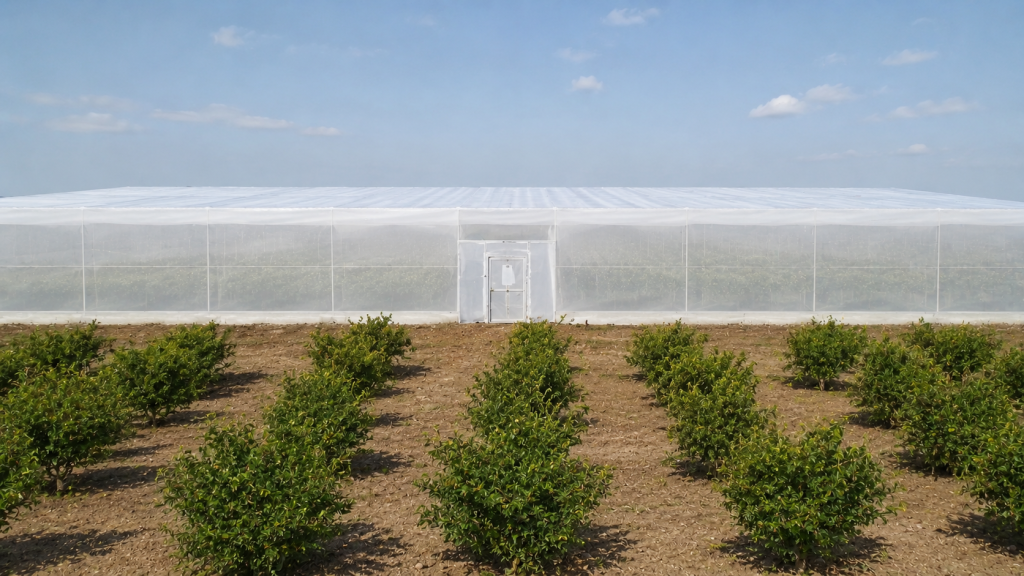
One of the most commonly used low-cost protected cultivation structures in India is the Insect Net and Shade Net Polyhouse. This setup is especially popular among farmers who want basic environmental protection without investing heavily into full climate-controlled polyhouses. Here is the complete guide and cost saving tips
As the name suggests, this structure mainly provides two types of protection:
- Insect protection through insect-proof netting
- Sunlight management through shade nets
Farmers can generally choose between 25%, 50%, and 75% shade nets depending on the crop requirement and local climate conditions. During peak North Indian summers, shade nets help reduce heat stress and sunburn damage on crops. These structures are commonly used for crops like tomatoes, cucumbers, leafy vegetables, nursery plants, and exotic bell peppers during their suitable growing seasons.
If constructed according to government-approved subsidy standards using proper GI pipe structures, this type of polyhouse can cost around ₹30–45 lakh per acre depending on design, material quality, and height. With government subsidy schemes, the effective farmer cost may reduce by nearly 40–50%.
A lower-cost variation of this setup is the Wire Net Insect Polyhouse. Instead of heavy GI pipe structures throughout the farm, metal rope wire support systems are used, which substantially reduce construction costs. These setups generally cost around ₹10–12 lakh per acre, making them attractive for budget-conscious farmers.
However, farmers should clearly understand that these are not climate-controlled polyhouses. They only provide partial environmental protection. The structure works more like a wind breaker rather than a complete wind stopper. During storms and heavy rainfall, crop damage may reduce because wind intensity and raindrop impact get partially controlled, but the risk is not eliminated.
Major Disadvantages
- No proper climate control
- No VPD (Vapour Pressure Deficit) management
- Limited temperature regulation
- Humidity remains uncontrolled
- Higher disease pressure during monsoon
- Lower winter protection
- Reduced suitability for premium year-round production
- Cannot fully protect crops from extreme weather conditions
2) Naturally Ventilated Polyhouse (NVPH) – The complete Guide
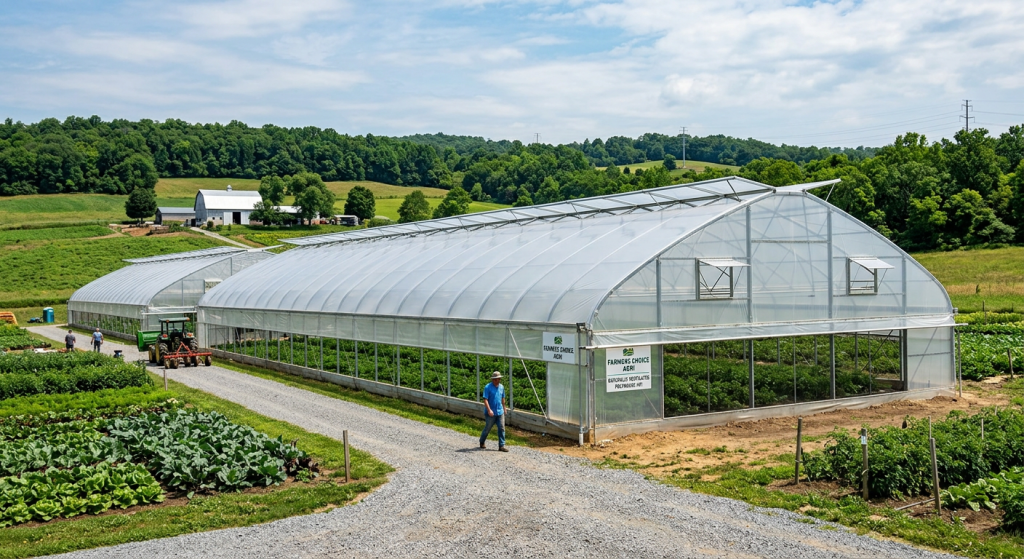
Naturally Ventilated Polyhouse, commonly called NVPH, is one of the most commercially used protected farming structures in India for high-value vegetable cultivation. Compared to simple insect net and shade net structures, NVPH provides significantly better environmental protection and crop stability while still remaining cheaper than fully climate-controlled greenhouses. Here is the complete guide and cost saving tips for NVPH
A standard government-approved Naturally Ventilated Polyhouse generally costs around ₹50–60 lakh per acre depending on height, pipe thickness, ventilation design, and covering material quality. With government subsidy schemes, farmers can reduce their effective investment by nearly 40–50%.
The biggest practical advantage of NVPH is season extension. Farmers can usually start cultivation nearly 1 month earlier and continue production around 1 month later compared to open-field farming or basic insect net structures. This becomes extremely important commercially because early-season and late-season produce often receives premium market prices due to lower availability.
Crops commonly grown inside NVPH include:
- Exotic bell peppers
- Cucumbers
- Tomatoes
- Cherry tomatoes
- Leafy vegetables
- Flowers and nursery crops
Some farmers who do not want to go through the lengthy subsidy approval process choose to construct low-cost private NVPH structures. These structures generally use lower GI pipe quantity, smaller pipe thickness, and reduced structure height. While these are still commercially usable, they are comparatively weaker against strong winds and storms. However, if managed properly and built by experienced fabricators, they can still produce good commercial crops. Such low-cost NVPH setups generally cost around ₹20–30 lakh per acre.
Advantages Over Insect Net Polyhouse
- Better temperature moderation
- Improved humidity management
- More stable growing environment
- Better crop quality and uniformity
- Longer crop duration and season extension
- Higher yield potential
- Better rain protection
- Reduced pest entry
- More suitable for premium vegetable cultivation
- Better support for trellising and vertical farming systems
Limitations
- Still not fully climate controlled
- Internal temperature can become very high during peak summers
- Requires proper ventilation design
- High humidity can still create fungal disease pressure
- Lower wind resistance in cheaper private structures
- Plastic maintenance and replacement cost every few years
3) Fan and Pad Polyhouse
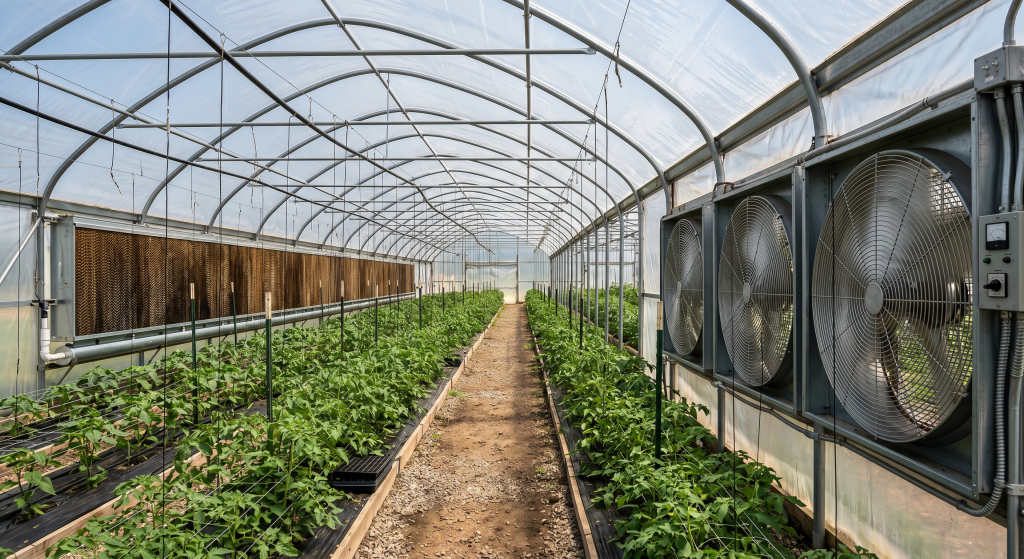
Fan and Pad Polyhouse is one of the most advanced protected farming systems used in India for growing premium and exotic crops. Unlike Naturally Ventilated Polyhouses (NVPH), these structures use exhaust fans and cooling pads to actively control temperature and humidity inside the polyhouse.
A standard government-approved Fan and Pad Polyhouse generally costs around ₹70–80 lakh per acre. Government subsidy can reduce the effective cost by nearly 30–35%.
These structures are mainly used for high-value crops such as:
- Lettuce
- Arugula
- Exotic leafy greens
- Bell peppers
- Cucumbers
- Cherry tomatoes
- Herbs and hydroponic crops
Some farmers avoid the subsidy process and instead build low-cost private Fan and Pad tunnels using lower-height structures and reduced GI pipe quantity. These are usually made in smaller tunnel units of around 500 square meters each. While not as strong as full commercial structures, they are still commercially usable and can reduce costs substantially.
Such setups generally cost around ₹40 lakh per acre and are becoming popular among growers supplying exotic vegetables to urban markets, restaurants, and premium grocery chains in North India.
One major advantage is that farmers can grow exotic crops almost throughout the year and capture premium market prices when open-field supply is low. The main exception is monsoon season, where excessive humidity and disease pressure still create major challenges.
Advantages
- Better cooling and temperature control
- Suitable for premium exotic crops
- Higher yield and crop quality
- More stable production compared to NVPH
- Good for hydroponics and leafy greens
- Better summer production capability
Disadvantages
- High electricity consumption
- Expensive setup and maintenance
- Cooling efficiency reduces during monsoon humidity
- Requires skilled management
- Higher disease risk if humidity is not controlled properly
- Low-cost structures are weaker against strong winds
Conclusion
At DhartiAgro — The Honest Agriculture Consultancy — we believe polyhouse farming should be treated as a proper business, not just a trend. Every farmer and investor has different land conditions, climate, budget, and target crops. Instead of pushing unnecessarily expensive systems, we focus on recommending practical polyhouse setups that provide the best possible ROI on your hard-earned investment. Sometimes a lower-cost polyhouse setup with stable returns makes far more sense than a heavily marketed high-cost structure. Our goal is simple — help you save money, reduce risk, and build a commercially sustainable polyhouse project.